Where Disability Activism Began
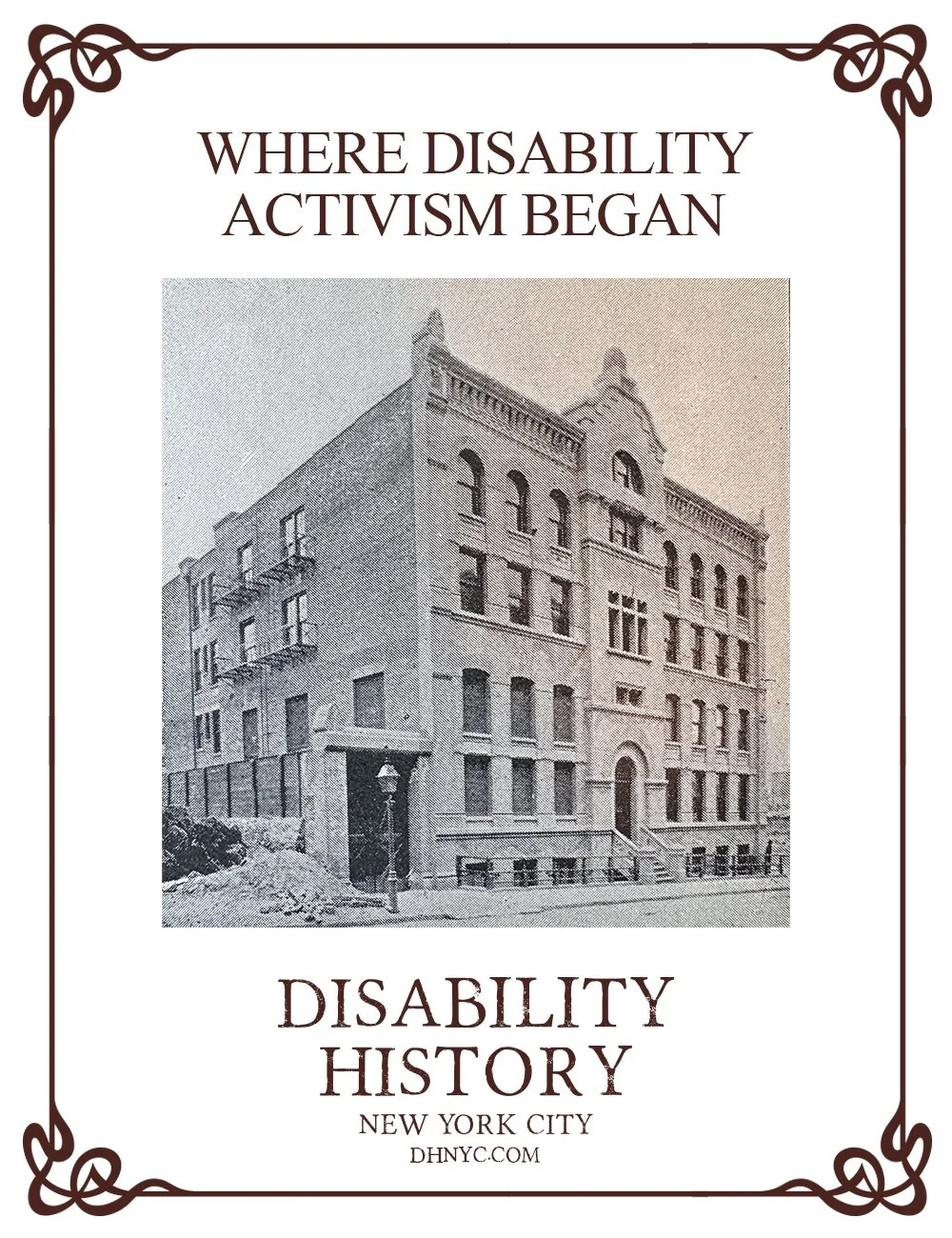
In image No. 1: the Henrietta Industrial School building, at 224 West 63rd Street, in 1893, prior to its acquisition by the Children’s Aid Society.
Lincoln Center is New York City’s most famous performing arts complex. Ringed by the marble elegance of the Opera House, the Music Hall and the Theater, its enormous plaza is usually filled with performers, fashion models, and the begowned and betuxed. You’d never guess that it used to be a low-income neighborhood known for its tenements, gas tanks, and industrial railway.
Running from about 59th Street to 70th Street, west of Broadway, the original name for the area was Lincoln Square. Starting around 1900, it was often called San Juan Hill. It was here that disability activism in the City made its start, more than 125 years ago.
The catalyst was the little remembered disability pioneer, May Darrach. Darrach was born in 1869, in New Jersey. At less than three years old she was diagnosed with spinal tuberculosis, and was unable to walk unaided until age thirteen. In 1896, at the age of twenty-seven, Darrach’s tuberculosis put her into the hospital. It was hardly her first time in-patient. But from this particular hospital stay Darrach emerged forever altered, charged with a mission to do something tangible for what she (and everyone else) then referred to as “crippled children.”
After being released from the hospital, Darrach helped organize a new project—the Guild for Crippled Children of the Poor. The new organization quickly attracted well-known figures as officers and Board members, including the pioneering social reformer and photojournalist Jacob Riis.
The turning point came when Darrach caught the attention of Charles Loring Brace, Secretary of the Children’s Aid Society (or CAS). Darrach wagered Brace that there were hundreds of disabled children hidden away in the poor parts of town, unreached by school, church, or any other outside influence. He was dubious, but Darrach knew they were there--she’d shared hospital wards with them. Now she slogged through the tenements and documented them. As far as I know, this was the first survey of disability in the general population. Darrach then presented her findings to Secretary Brace, and made her pitch. She must have been most persuasive, for Brace became an officer in her Guild for Crippled Children, and put CAS’ enormous resources behind Darrach’s ideas.
Owned and operated by CAS, the Henrietta Industrial School, at 224 West 63rd Street, was a roomy four-story building for the poor children of San Juan Hill (it was previously known as the Home of Industry & Refuge for Discharged Convicts). By 1898 several rooms at Henrietta had been renovated and set aside for the instruction of disabled children. They received specially-built furniture, wheelchairs, and reclining chairs. Connected to the bathroom was a dressing room that included a table for massage treatments, a sitz-bath, and storage for medical equipment, all of which was managed by an on-staff nurse. The facility included a program of personal hygiene for the pupils--“bathing,” as CAS called it--important in a City where adequate tenement bathrooms were almost unknown. A kitchen and dining room provided a “substantial lunch”—again, important at a time when childhood malnutrition was not uncommon, and was a likely contributor to early-age disability.
Depending on their ages, genders and capabilities, the children received kindergarten, a basic education, training in “home economics,” or manual skills training to make them at least potentially employable. The staff offered medical recommendations and health instruction to parents, and classes were occasionally visited by surgeons, who provided referrals to hospitals and performed some minor procedures on the spot.
Through CAS, Darrach had created the nation’s very first educational program for children with disabilities. Drawn from a catchment that stretched from approximately 50th Street to 70th Street, classes at Henrietta attracted enthusiastic local support. As a turn-of-the-century account put it:
One excitable Irish woman vociferously expressed the sentiment of the neighborhood as she followed the wagonette [used to transport the students] for half a block with arms thrown up, exclaiming ‘The Lord A’mighty bless ye for this, and reward ye in heaven. The Lord A’mighty bless ye for rememberin’ the cripples.’ One of [the local] boys constituted himself a guard of honor to keep the naughty boys from riding on the steps of the wagonette . . . ‘Ye jes’ better leave these kids alone; it is bad enough to be a cripple, and yer ought to be ashamed an’ glad they can get to school anyhow.’ The coming of the wagonette is looked for by the little ‘shut ins’ with an eagerness that is almost pathetic, for to many it is their only chance for a little fresh air and change of scene.
Meanwhile, Darrach founded an entity of her own, the Darrach Settlement Home for Crippled Children, on West 69th Street, at the northern end of San Juan Hill. The Darrach Settlement Home was a fifteen- or twenty-bed facility. Like Henrietta, it provided a combination of education, medical care, skills training, social work and trips to the country. Unlike the school, however, the Darrach Home provided beds, room and board—shelter—for kids who had been abandoned, or were too acutely disabled to live with their families.
Many more educational programs and organizations for disabled children followed. By 1905 there were no less than sixteen private charitable organizations serving people with disabilities in New York City. Of course, their focus was far from what we think of as “activism” today, but compared to the general neglect and frequent homelessness that had previously dogged New Yorkers with disabilities, they were fundamentally important. They marked a new cycle in the wave of elite-funded and Progressive-era efforts, now forgotten, which I have dubbed the Dickensian Disability Movement.
And spurred on by May Darrach, America’s first disability activist, San Juan Hill was the springboard for it all.
Note: a version of this entry appeared in Able News, ablenews.com
by Warren Shaw
