THE PROBLEM WITH TINY TIM
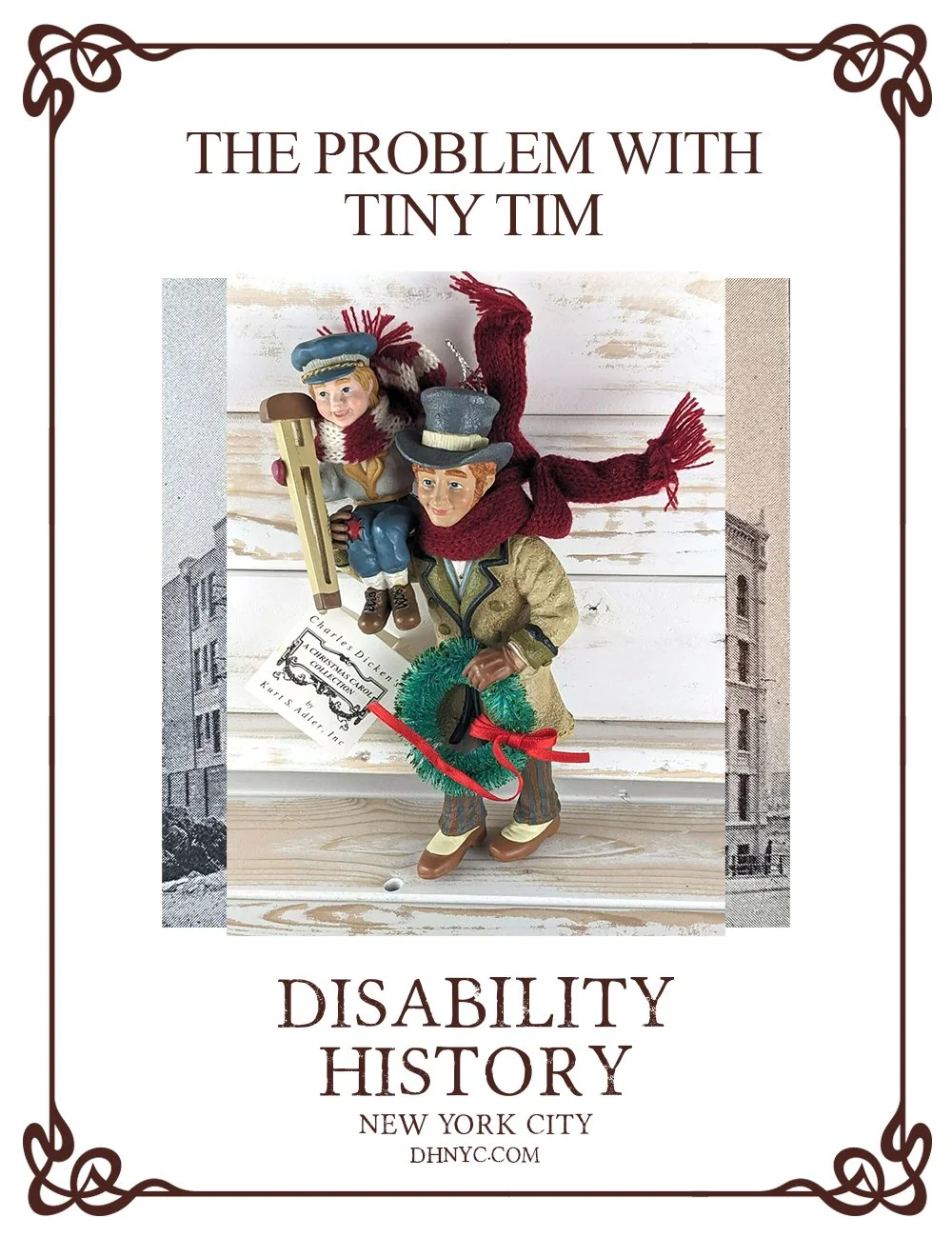
In image No. 1: A figurine of Tiny Tim and his father, Bob Cratchit.
Charles Dickens’ novella, “A Christmas Carol,” is a staple of the modern imagination. It’s both a promise of redemption and a supernatural warning—humanity shrivels under the love of money—and it retains a currency, a hold on the anxieties and fears of the industrialized world, that is practically unmatched. Probably the most remade story in all of American media, the bones of the tale of Ebenezer Scrooge’s Christmas Eve moral reclamation are known to most everyone in the United States.
As a piece of journalism, Dickens’ work is hard to fault. It was Dickens’ generation that first encountered mass-scale proletarian poverty, and its harsh repression. To confront these hardhearted developments (“Are there no prisons? Are there no workhouses? The treadmill and Poor Law are in full vigor?”), “A Christmas Carol” focuses mainly on the harm that capitalism imposes on the capitalist himself, in the person of Ebenezer Scrooge. Scrooge is a wealthy London businessman on the cusp of old age, a man of cold and studied penury, who even on Christmas Eve denies kindness and comfort to all, including himself.
“A Christmas Carol” captured one more social change that came with the Industrial Revolution: the increased numbers of people with disabilities, thanks to industrial accidents, malnutrition and epidemic disease. That phenomenon is embodied, of course, in Tiny Tim, the disabled youngest son of Scrooge’s clerk, Bob Cratchit.
But here the tale gets into difficulties, and has earned the wrath of the disability community.
Scrooge awakens Christmas morning transformed by his overnight encounters with the ghosts of Christmas Present, Past and Future. He remakes himself into the very soul of generosity, laughter and kindness—a switch that Dickens eagerly commends, and recommends: “May that be truly said of us, and all of us!”
That is the central message of Dickens’ tale—the possibility of personal transformation leading to social change.
Dickens is no revolutionary. For all the criticism he directs at Scrooge (and at capitalism in general), as George Orwell put it, “Dickens’ whole ‘message’ is one that at first glance looks like an enormous platitude: if men would behave decently the world would be decent.” Who could object to such a sweet, simple prescription for the world’s ills? And since the story’s moral questions about our wage-labor society are every bit as relevant now as they were 175 years ago, it’s no wonder that “A Christmas Carol” remains a widely beloved tale in the 21st Century.
Dickens’ moral precept—universal decency—is not the problem.
The problem is Cratchit’s little boy, Tiny Tim.
Tim is fated to die if Scrooge does not change, but because Scrooge did change, the narrator informs us that “Tim did not die.” Yet Tim is apparently devoid of thoughts or hopes for himself. The only significant statement attributed to him is the entirely other-directed wish that his disabled self might lead others to remember He “Who made the lame walk and the blind see.” With no aspirations and no complaints, Tim isn’t a fully-fleshed character, he’s a mirror, a barometer of Scrooge’s moral reclamation. In a tale about the potential for personal transformation and shared humanity, Tim is the moral axis of the story, but he is not an actor in the story.
What’s more, Tim is lovable for his perfect sweetness and innocence, but these are qualities of childhood. What happens when he grows up, when he’s aged out of moral mirroring? There’s not a word. “A Christmas Carol” might as well be “Silent Night.”
All this is profoundly irritating to the disability community. Why not let Tim in on some personal transformation too? Would it have been so difficult for Dickens to have gone beyond merely prognosticating that the boy did not die? Couldn’t he have added a sentence or two saying that Tim went on to learn a trade, perhaps even took a wife? Had children?
The negative influence of the tale is that it reinforces the nondisabled population’s tendency to overlook the personhood, the individuality of people with disabilities, and instead see only their impairments. Worse still, because “A Christmas Carol” retains its power, its truncated, perpetual-child example of disability constitutes an ongoing cultural barrier.
It is for these reasons that, for many within the disability community, Tiny Tim has become one of the most reviled figures in literature.
This comes as a big surprise to most nondisabled people. Accustomed as they are to seeing Tiny Tim as the beloved son of the loving Cratchit family and one of the hinges of Scrooge’s transformation, the logic behind Tim’s low status is anything but self-evident to them. During one conversation about Tiny Tim with a nondisabled professor of media studies, I was flatly accused of misunderstanding the story altogether.
To that, of course, I say “Bah, Humbug!”
Note: a version of this entry appeared in Able News, ablenews.com
by Warren Shaw
