Eunice Fiorito
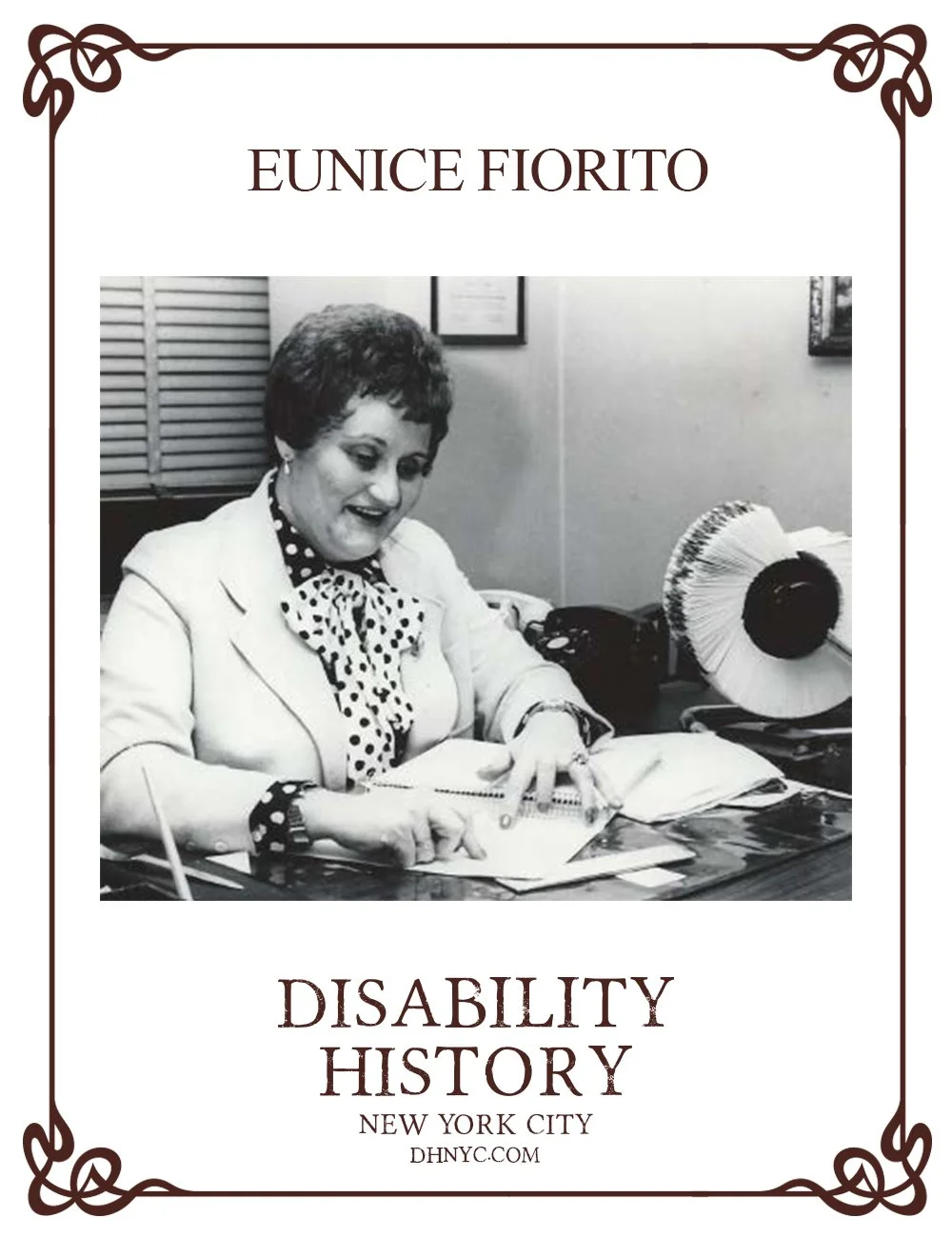
In Image No. 1 – Eunice Fiorito ca. 1978, when she was Director of the Mayor’s Office of the Handicapped.
Eunice Fiorito was a charmer, a blind, red-headed woman who came on strong. Tall and physically imposing, always beautifully dressed and scented, with a Midwestern twang that put you right at ease. But beneath that sugary crust she was bold as brass. If there was someone she wanted to meet she was known to ask a sighted friend to aim her in the right direction, and she would literally walk right into them! Then she’d turn on the savoir faire and jawbone until she got her way. And she usually made a friend, whoever it was.
The first time I met her, around 1969, when I was ten or eleven, Eunice piled into the passenger seat of my parents’ car, an aged gray Rambler station wagon. She immediately turned round to face me, and trained all of her attention on me. I’d recently gotten a gift of a gold and ruby ring, and I was very proud of it. I mentioned it to her. She instantly squealed “Ooh, let me see it!” I gave her my hand and she examined the little ring and oohed and aahed over it.
Eunice and my family spent a lot of time together in those days. We went to hang out at her apartment on the East Side, we all had dinner together, and she stayed over with us at a little house we rented one summer in the working class suburb of North Babylon—that was our Big Foray Into The Country for my incredibly urban Upper West Side family. Eunice nicknamed me Turnip for some reason, and she was an honored guest at my bar mitzvah, in 1971.
Eunice was part of the second wave of the founders of the modern New York City Disability Rights Movement, along with people like Anna Fay and Marilyn Saviola, and probably the first to come to the movement with relevant professional credentials. A native Chicagoan who lost her sight as a teenager, Eunice came to New York City and earned a Master’s Degree in Social Work from Columbia University, graduating in 1960.
She was living at the 34th Street YMCA at the time, where she became friends with Anne Emerman, later a Director of the Mayor’s Office for People with Disabilities. They traveled the City together--as Anne described it to me, “I was the eyes, she was the power.”
In 1970 Eunice became Coordinator of the Mayor’s Advisory Committee on the Handicapped. As the only salaried member of that body, she did so well that in 1973, when Mayor Lindsay upgraded the Advisory Committee into the Mayor’s Office of the Handicapped (MOH, today known as the Mayor’s Office for People with Disabilities, or MOPD), Eunice was named its first Director.
The upgrade showcased Eunice’s willingness to confront her employer. She staged a one-woman sit-in on the steps of City Hall, campaigning for the upgrade day after day, then she surprised the Mayor by bringing hundreds of activists to a meeting where the press was present. She forced an exasperated Lindsay to give in.
A few years later, during the Fiscal Crisis, Eunice fought successfully to keep MOH from being defunded and shut down, staging a rally and pizza party, again in front of City Hall.
During the OPEC Oil Embargo, in the Spring of 1974, Eunice took MOH to its most radical moment, helping coordinate a huge demonstration against the State’s gas rationing program, because it did not provide an exemption for disabled drivers. Hundreds of demonstrators turned out, right in front of Governor Malcom Wilson’s midtown Manhattan office. After being rebuffed by the Governor’s staff they poured out onto the street and blocked traffic on Sixth Avenue for hours, in the middle of a workday—WITHOUT a permit! Mayor Abraham Beame was furious.
And then, in 1977 Eunice went national, as a leader of the Section 504 Sit-Ins, perhaps the greatest direct action in the history of American disability activism.
Section 504 of the Rehabilitation Act of 1973 prohibited discrimination against people with disabilities in any program or activity that received federal funding—libraries, schools, public transportation and the like. Section 504 was potentially revolutionary, maybe even transformative. But it wasn’t self-enforcing--implementing regulations had to be passed first, and by 1977, four years after Section 504 passed, no regs were in place. There was only a draft.
Eunice had co-founded (with Franke Bowe) and was then President of the American Coalition of Citizens with Disabilities (ACCD). ACCD was the most serious effort to date to create a national disability umbrella organization, formed largely on the outrage that followed President Nixon’s veto of the 1972 Rehabilitation Act.
In February 1977 ACCD began organizing protests at the United States Department of Housing, Education and Welfare (HEW), to press for enactment of regulations to implement Section 504. ACCD sent a letter to President Carter and HEW Secretary Joseph Califano warning that if Section 504 regulations were not issued by April 4, ACCD would hold sit-ins at HEW offices across the country.
Califano met with ACCD on April 4, and although he sounded receptive, he did not agree to sign the draft regulations. The very next day the sit-ins began in multiple locations—most famously in D.C., where HEW’s offices were occupied overnight—and in San Francisco, where the occupation ran a staggering 23 days, ending only after Califano signed the regs.
Prominently photographed onstage with Judy Huemann at a big rally, Eunice’s leadership role in the 504 Sit-Ins was a matter of public record. In another demonstration of Eunice’s savoir faire, instead of scorning her as a malcontent, HEW named her Vice Chair of a Section 504 task force, then hired her away from New York City. Eunice stayed at HEW for 19 years, until she retired.
Sometimes referred to as the godmother of the Americans with Disabilities Act, Eunice passed away in 1999, at age 69, leaving a legacy of accomplishment and forcefulness that few can hope to equal.
by Warren Shaw
Note: A version of this entry appeared in Able News, https://ablenews.com/
