Marvin Wasserman (1945 – 2024)
"A kind and principled leader."
Sharon Shapiro-Lacks, Board member and former Executive Director of the Brooklyn Center for Independence of the Disabled (or BCID).
"Marvin tirelessly devoted his effort, strength and whole self. Without him, the disability movement would look very different today."
Heidi Hirschfeld, President, BCID Board of Directors.
"Marvin shared his political savvy and promoted cooperation between groups."
Jean Ryan, President, Disabled In Action.
"Pioneering by organizing politically, Marvin saw a future in which the needs, rights and voting power of the community are acknowledged by those who run for office."
Jim Weisman, Legendary Movement Litigator.
“Marvin Wasserman was a strong advocate. He let you know what was on his mind without hesitation, he was not afraid of change, confrontation or even admitting when he didn't know something. It was my honor to work alongside him, and I was proud to call Marvin a friend.”
Christina Curry, Commissioner, Mayor’s Office for People with Disabilities.
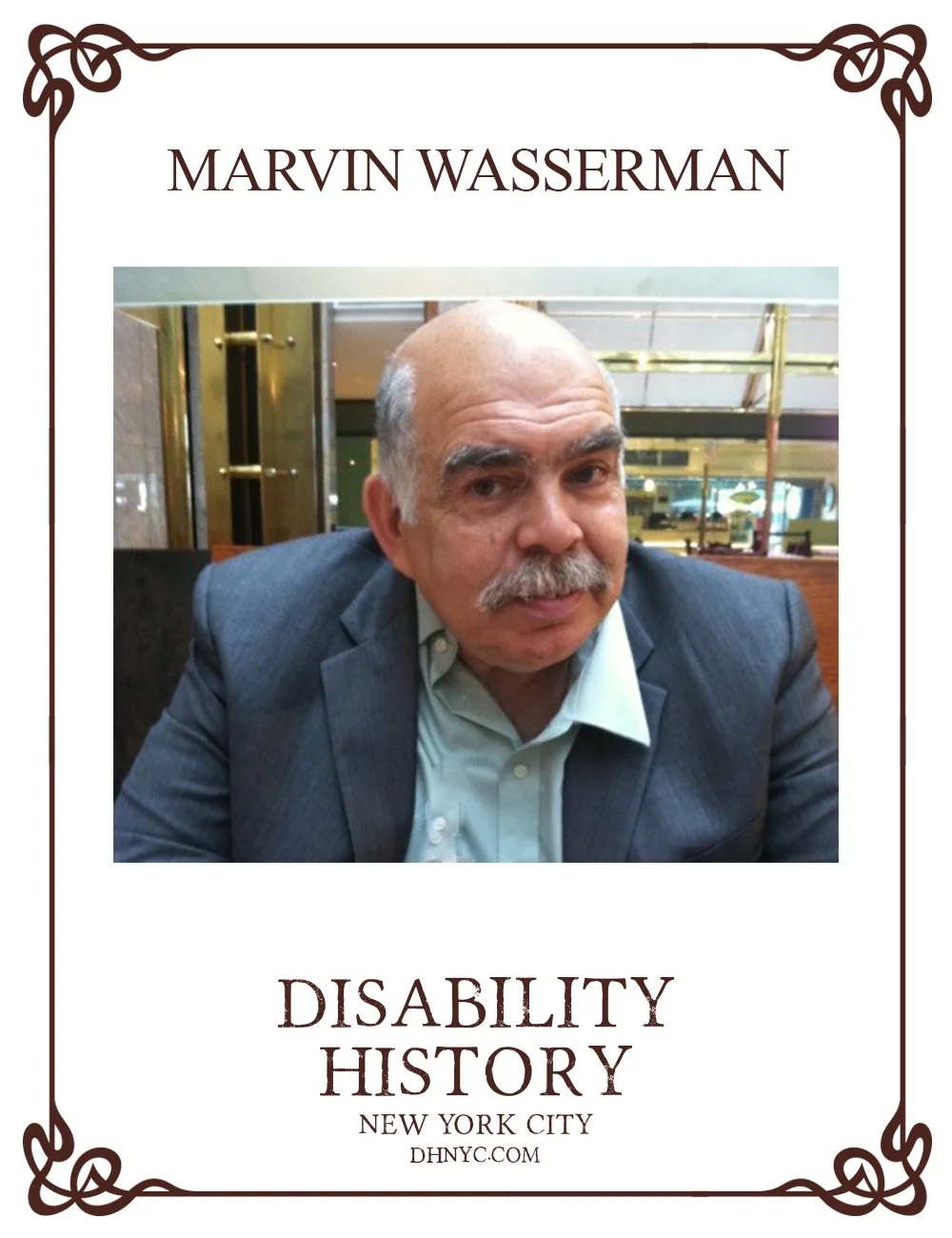
In Image No. 1, Marvin Wasserman, 2012. Photo by Rita Seiden.
Marvin Wasserman, a pivotal leader of the disability rights movement in New York City, passed away on Sunday, September 22, 2024, in California, where he had lived since 2012. He was 79 years old, and had been battling a recent diagnosis of leukemia and multiple myeloma. But his death was sudden and unexpected.
Marvin’s accomplishments include co-founding and leading the 504 Democratic Club and the Taxis For All Campaign, and reinvigorating the Brooklyn Center for Independence of the Disabled. He served on the New York State Democratic Committee, where he implemented a rule requiring Statewide accessibility for all party meetings. Nationally, he helped ensure that people with disabilities were included in the “goals and timetables” for selection of delegates to the 2008 Democratic National Convention.
To convey the mammoth impact of his achievements, let’s revisit the state of the City’s disability community around 1979, when Marvin’s career in disability rights began. It was an era when the absence of curb cuts forced wheelchair users to travel in the street instead of on the sidewalk. Busses, subways and taxis were unusable. So you saw very few disabled people out and about.
There were a number of disability rights groups, some of them quite potent, like Disabled In Action. There was an established liaison between the community and City government--the Mayor’s Office of the Handicapped (my father Julie Shaw was its Director at the time). Independent living centers like CIDNY and BCID had been established the year before. So there was quite a bit of organizational energy in our town. But it didn’t cohere very well, and disability activism consisted largely of separate and distinct campaigns that took on one issue at a time.
Marvin came to the City’s disability rights movement after many years’ experience in mainstream political activism and Democratic party politics. He’d run for Democratic District Leader and the New York State Democratic Committee, and served as President of the Queens County New Democratic Coalition, which worked in opposition to the infamous Borough President Donald Manes. These experiences had given Marvin an appreciation of the importance of building an ongoing presence and dialogue with elected officials.
Through his Democratic party work, Marvin had become aware of efforts to found issue- and demographically-focused political clubs, such as the Rachel Carson Club, which focused on environmental issues, and a lesbian and gay club. These examples planted the seed for what would become his most central accomplishment—a political club targeted to New Yorkers with disabilities.
The new Citywide political organization, the 504 Democratic Club, eventually developed a well-defined practice of endorsing electoral candidates, educating them on disability issues, and lobbying officeholders, just as Marvin had envisioned. The impact of this organization has been far-reaching. As the club’s longtime President, Michael Schweinsburg, told me, “504 Dems is known and respected throughout city government, in Albany and in Washington, D.C., and is considered one of the most powerful political clubs in New York State.” Among other things, the resulting alliances earned Schweinsburg a spot in the Eric Adams Mayoral transition team, a first for a City disability activist, and proof of the enduring power of Marvin’s conception.
Getting 504 Dems off the ground took several years, and in the process Marvin came into contact with another movement figure, Sandra Schnur (best remembered as a founder of Concepts of Independence). Sandra and Marvin got married in 1983, and they remained inseparable, until Sandra passed away in 1994. For many years afterwards Marvin hosted annual Passover seders in her honor, open to the disability community, and served as annual presenter for Concepts of Independence’s Sandra Schnur Advocacy Award.
Marvin’s success with 504 led to another major project—the Taxis For All Campaign. An outgrowth of the long fight for accessible busses and subway stations, the campaign achieved palpable impact: today, half of the City’s cabs are accessible to wheelchair users; e-hail cab service has been established; and companies like Uber and Lyft have agreed to important accessibility accommodations.
In 2008 Marvin was elected Executive Director of the Brooklyn Center for Independence of the Disabled, or BCID. BCID had been experiencing difficulties. But over the course of Marvin’s tenure BCID recovered and expanded. It took on high-profile projects like BCID v. Bloomberg, a federal class action that brought sweeping accessibility changes to the City’s emergency preparedness. Marvin set BCID on a course towards the powerhouse organization it is today.
In these and in innumerable other projects, Marvin raised the level of organization and the visibility of the City’s disability community. As Jim Weisman, the legendary movement litigator, put it, “pioneering by organizing politically, Marvin saw a future in which the needs, rights and voting power of the community are acknowledged by those who run for office.”
But in truth, I don’t think these institutional innovations fully capture what was so unique about Marvin as a leader, or explain the enormous outpouring of affection and sadness that flowed in response to his unexpected demise—truly a remarkable tribute to a man who had retired and moved across the country fully a dozen years before.
By way of an answer, I’m going to start with myself.
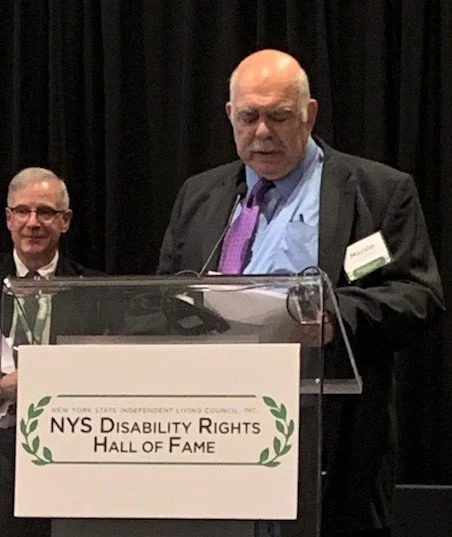
In Image No. 2, Marvin Wasserman accepting induction into the NYS Disability Rights Hall of Fame on behalf of the late Sandra Schnur. On the left is Brad Williams, E.D. of New York State Independent Living Council (NYSILC), which oversees the Hall of Fame. Photo by Rita Seiden.
I met Marvin in 2010, when he came to one of my history talks, and he really changed my life as a chronicler of the City’s disability history. Marvin became my sherpa, my guide to disability activism in the present tense. Marvin unhesitatingly shared everything he knew, and contacts for everyone he knew (and he seemed to know everything and everyone, all across the USA). Over the years since, whenever I needed background or context he was right there, sharing his knowledge instead of guarding it.
And it wasn’t just me. As Gabriela Amari put it, “We met at a healthcare town hall. After the meeting, Marvin invited me to BCID. I went from being a shut-in to a Housing Education Specialist. Marvin brought me back into the world.
“Marvin would come downstairs every morning at BCID’s offices, and stop by each person's cubicle to say good morning. Not about work, just seeing how each of us were doing. He was a beautiful, caring person and a wonderful advocate but mostly to me, he was a great and true friend whom I will miss deeply.”
Or take T.K. Small: “Back in 1994, I ran for New York State Senate as a dreaded Republican. At the time, the district stretched from Brooklyn to the Lower East Side of Manhattan, where Marvin lived. Years later I learned that Marvin put his political views to the side and voted for me. In his gravelly voice he said ‘You are the only Republican I have ever voted for. Don't tell anyone…’”
State Assembly member Jo Anne Simon wrote that “this work can sometimes be maddening. Marvin, however, knew how to work with people, how to coach and educate as he advocated. He knew how to run an organization with both brains and heart.”
Becky Ogle, a national movement leader and political adviser, said that “My first role in the Democratic Party was Director of Disability Outreach for the Clinton/Gore 1996 Re-election campaign. Marvin called me completely out of the blue. He introduced himself as President of the 504 Democratic Club, and proceeded to give me my first tutorial on all things 504 and New York.
“Marvin was a gentle teacher. He was a gracious human being, who truly embodied all that is right in the world. He always made sense. Marvin leaves me a better person for having known him as a friend and fellow activist.”
This, I think, gets to what made Marvin so beloved. He was a peerless peer, devoted dually to the movement’s progress and the people who comprised it. As Joe Rappaport (the ED of BCID) told me, “whatever the issue, Marvin was in the middle of it and, of course, on the right side. Marvin was a force. He just kept pushing, in that slow, gravelly voice, often repeating his questions, never giving up.” Yet he was always gracious. The art of collegial disagreement, nearly extinct in our era, was alive and well in Marvin Wasserman.
Marvin was aware of his capabilities—as he once told me, you aren’t a leader if no one is following you—but he was no diva. He never showboated, never took a stand for the sake of drawing attention to himself.
It seems absurd to say this (and at age 66, it feels absurd to write it), but I feel as if I’ve lost my second father.
Perhaps Mike Schweinsburg put it best: “Marvin was my mentor and among my very best friends. I was honored to stand as best man at his wedding to his adored second wife, Rita Seiden. He was a true giant in the community and his presence continued to be felt long after he left New York City.
“There are many heroes in the disability community, but Marvin was a legend, and as it is said, ‘heroes get remembered, but legends never die.’”
Rest well, my old friend.
by Warren Shaw
DHNYC thanks Gabriela Amari, Christina Curry, Heidi Hirschfeld, Becky Ogle, Joe Rappaport, Jean Ryan, Michael Schweinsburg, Sharon Shapiro-Lacks, T.K. Small, Jo Anne Simon, and Jim Weisman for their assistance in the preparation of this entry.
Note: A version of this entry appeared in Able News, https://ablenews.com/
