Edith Prentiss
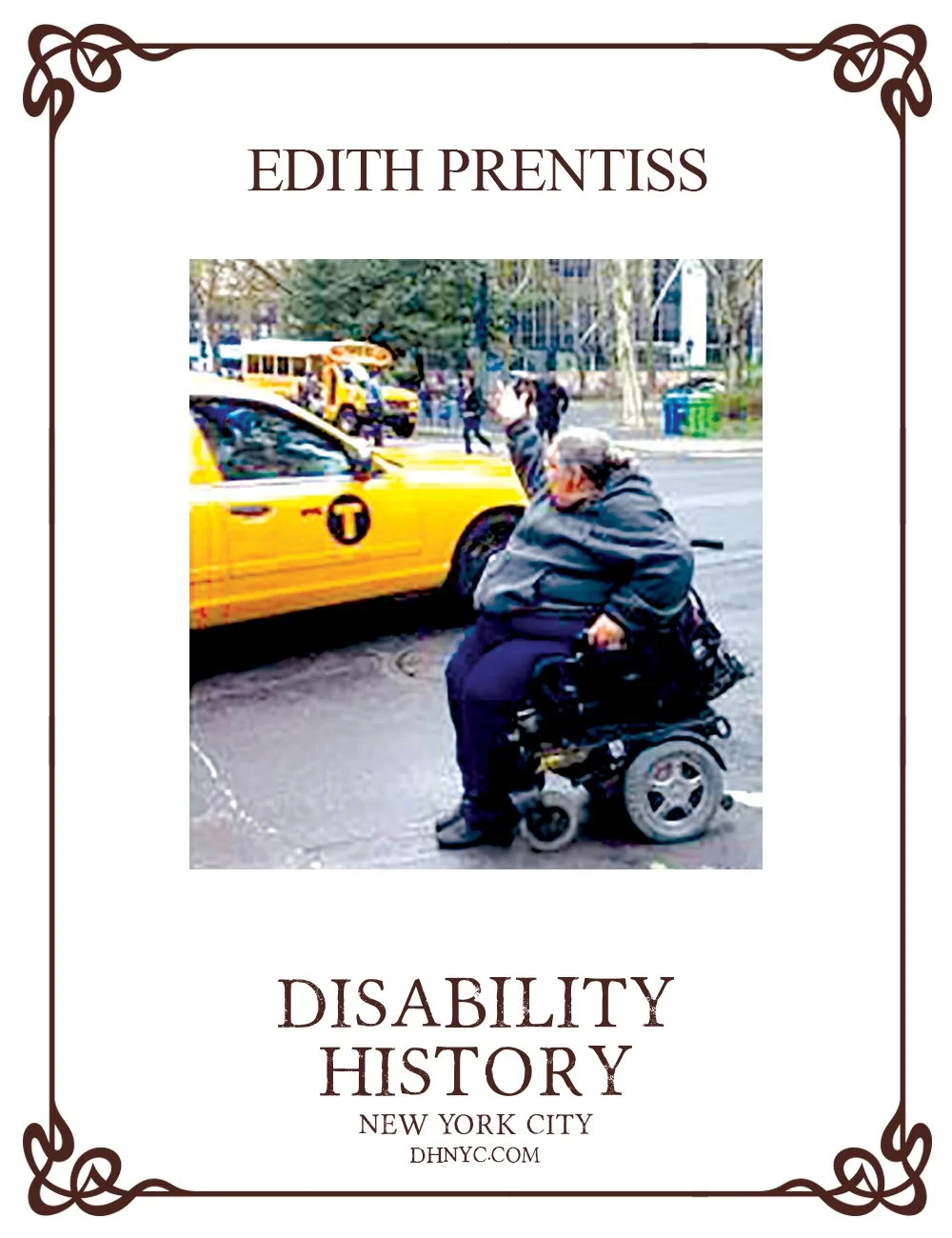
In Image No. 1 – Edith Prentiss attempting to hail a yellow taxi
One night many years ago, as I was getting ready to give a history lecture for the City of New York, someone pointed to a woman in a motorized wheelchair and warned me, “be careful. She’s trouble.” After I finished, as everyone filed out the woman in the chair complained, loudly, about how slowly the nondisabled people were moving. I immediately set up an appointment to interview her.
It was, of course, Edith Prentiss, one of the New York City movement’s most outrageous personalities. She insisted on meeting me in Columbus Circle, a long way from her home in Washington Heights. I found her to be a sweet person who greatly enjoyed living up to her reputation.
Edith could certainly be trouble, but it was always good trouble. Edith was known to give a hard time to an ill-prepared public official, but she fought the fight on innumerable accessibility issues, both great—subway access, police precincts, emergency preparedness, public parks—and small: complaining about the stubby pencils in medical offices, because people with limited manual dexterity couldn’t manage them.
When the City considered a ban on plastic straws in restaurants as an environmental conservation measure, Edith and other people with disabilities attended the hearing, intending to voice their opposition on behalf of people who couldn’t drink without the straws. As the hearing went on and no one in a wheelchair was called on to present, Edith finally raised her voice—“Hey we’re here to speak! We have an opinion too!” They got their chance, and the upshot was a compromise—restaurants were to keep a supply of plastic straws available for use upon request.
Edith served as President of the 504 Democratic Club, Vice President of Disabled In Action, and was chair of the Taxis For All Campaign. She came up with a wonderful one-liner to describe the scarcity of accessible cabs circa 2004: they were “like unicorns. You have to be pure to catch one.”
A Long Island native who became disabled as an adult, Edith began her career as an outreach caseworker for a senior citizens center. Along with innumerable other public memberships, Edith was a member of the community board in her Washington Heights neighborhood, where she was such a well-known figure that after her demise in 2021, a local street was named in her honor, and a plaque went up in her local subway station.
There’s a documentary about Edith in the works. Aptly enough, the working title is “Hell on Wheels.”
Note: a version of this entry appeared in Able News, ablenews.com
by Warren Shaw
