The Museum of Disability History at the Viscardi Center
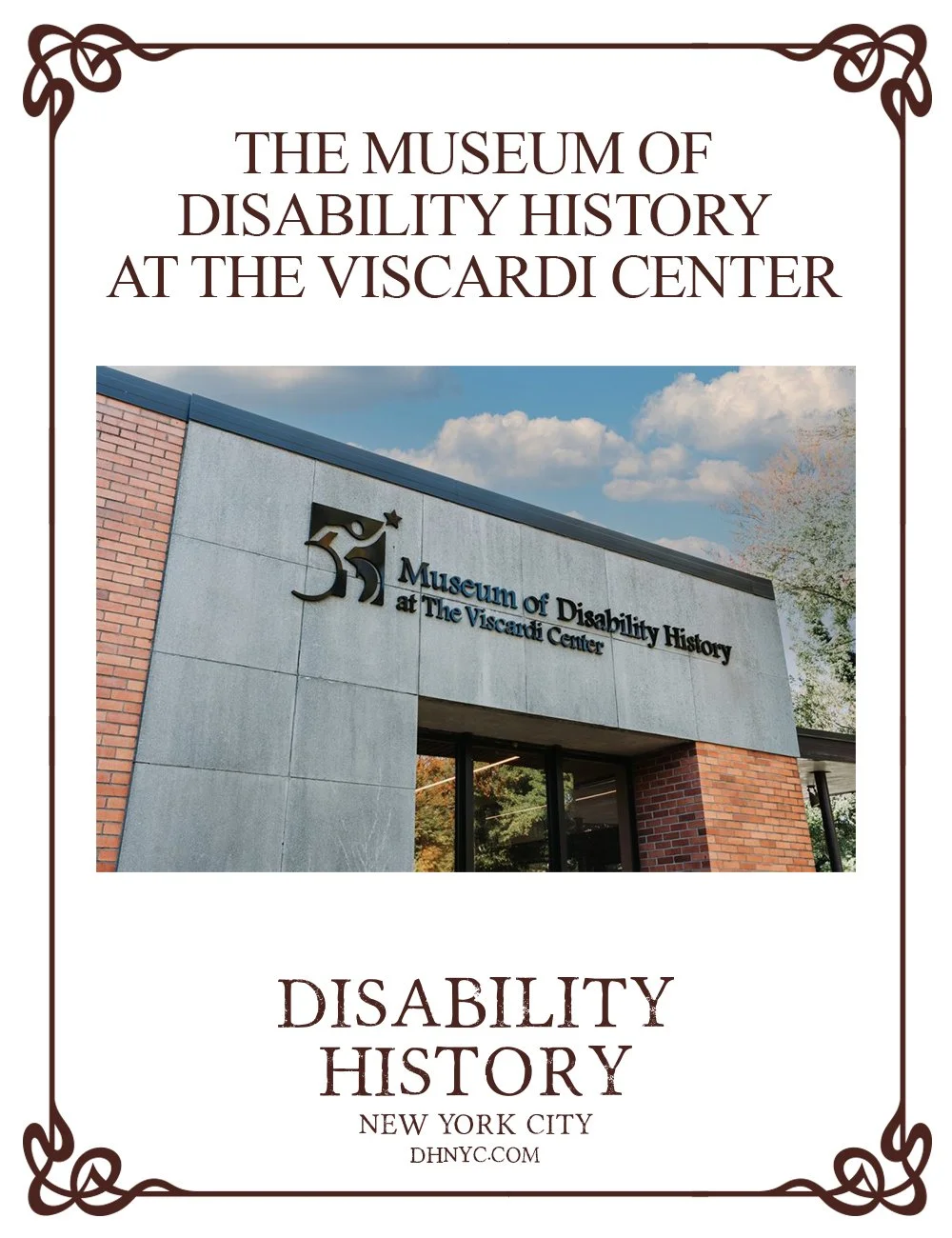
In image No. 1: the exterior of the Museum of Disability History.
On a torrentially rainy afternoon during the fall of 2025, I went to the campus of the Viscardi Center in Nassau County for the “soft launch” of the newly-rebirthed Museum of Disability History.
Despite the weather, Viscardi’s entrance hall was bursting with guests, public officials, media, and students. Nassau county executive Bruce Blakeman began the afternoon by acknowledging Viscardi’s unique significance as a disability resource and educational institution. He congratulated its ongoing expansion, and noted that the Museum of Disability History is the only such institution in the United States.
Speeches by Viscardi officials and local elected representatives followed. Their points were aptly summarized by Viscardi Board chair Steven Markowitz: “we expect the museum in the coming months and years to host school groups and veterans, businesses and families, nonprofits, and disability students and scholars and a host of others, to learn about and celebrate the complex and transformative history and culture of the disability community.”
Then came the ribbon cutting. The assemblage made its way to the entrance of the museum’s exhibition space, where Viscardi’s President, Dr. Chris Rosa, and County Executive Blakeman worked an oversized set of shears on a big, hapless blue ribbon.
Then they opened the doors to a large square room. Inside was a tantalizing and broad smattering from the museum’s collection, which spans centuries and crosses the nation. Its very breadth underscored one of the exhibit’s points: “there is not one single, uniform disability history in the United States, but many.”
Grouped into what the exhibit called “portals,” images and artifacts and text blocks provided information on subjects like the independent living movement, including Ed Roberts and the Berkeley IL Center; and sanitariums, deinstitutionalization and Willowbrook, and the fight against electroshock. There was a display about the influence of eugenics on ideology and policy, including the fight against forced sterilization. Another portal concerned modern representations of disability, such as a wheelchair-using Barbie.
There was considerable material on the history of assistive technology, from orthopedic shoes to artificial limbs, and an antique wheelchair. Journalism and advocacy by people with disabilities spanned a wide gamut, beginning with Grit-Grin, a 1929 monthly published by residents of tuberculosis wards, and Mouth, a magazine from the 1990s. One fascinating display concerned century-old puzzles that were used to test the intellectual capacity of people passing through Ellis Island. There was even a section on disability advocacy by superstars, like John Lennon’s 1972 benefit for the residents of Willowbrook.
The tenor of the portals ranged from defiant to celebratory. I was delighted to see an emphasis on appealing to school-age children.
A crowd favorite was a Braille edition of Playboy magazine (no pictures), but the most spectacular highlight was a mint condition, baby blue Invacar, a single-seat, three-wheeled vehicle produced as a mobility aid in England between 1948 and 1977. The exhibition room was aptly paired with an adjacent display about Dr. Henry Viscardi, which included a stunningly preserved version of his office, crammed with materials and mementos from his unique career as an activist, author, lobbyist and educator.
Over the course of the afternoon I spoke with the museum’s director, Natalie Reyes, and Dawn Nolan, Viscardi’s Senior Vice President for Program Development. For me, as a longtime booster of disability history as a subject all its own, it was a rare pleasure to be surrounded by like-minded people, and to share their enthusiasm for Viscardi’s latest accomplishment.
Next came a conversation with Viscardi’s President, Dr. Chris Rosa. A disability studies scholar, he was the longtime Assistant Vice Chancellor for Student Inclusion Initiatives at the City University of New York (CUNY). It was in that capacity that he and I first met, back in 2013 or so. I asked him about the history of the museum (which I recall chiefly as a website that belonged to a collection in Buffalo, a very long drive from New York City).
Dr. Rosa told me that “I almost literally stumbled into the collection. I was with a group of student leaders at a conference in western New York, and we were looking for things to do and see during our downtime. To my joy there was a museum of disability history, only a few miles from our hotel. The students and I took a day trip, and were utterly blown away. It was by no means exhaustive, but it was a noble effort to weave a coherent narrative, and a good point of entry to engage in the larger understanding of disability.”
Yet the Buffalo location became “a casualty of the pandemic. We’re very grateful to the stewards of that museum. They did museums the old fashioned way, they kept the lights on by keeping patrons coming through the door, and when the pandemic made that very difficult, there came a point where they needed to close their doors.
“I was heartbroken, because I recognized that it was a jewel. Out of admiration and remorse, I called the director of the museum, David Mack-Hardiman. He was also feeling the weightiness of the loss, so I asked him ‘what’s the future of the collection? Where does your board envision the collection living?’ And then the big one—‘would you consider moving it downstate?’
“I had an eye on bringing that collection to the College of Staten Island,” but when Dr. Rosa moved to Viscardi the idea came with him. “With the blessing of CUNY and a commitment at the College of Staten Island to partner with us, we agreed to pursue it together, with the museum having a home here at the Viscardi Center, which we see as a cradle for disability history and culture.
“We don’t have a library here, or an archive, but at the College of Staten Island, which is on the former campus of Willowbrook, we have a brilliant archivist and a library which is really committed to including disability history and culture. The President of the college, Tim Lynch, is on the board of the museum, and he understands the unique and sacred responsibility to tell the story of American disability history, in its totality.”
The official opening date for the Museum of Disability History is scheduled for late January, 2026.
Note: a version of this entry appeared in Able News, ablenews.com
by Warren Shaw
