Judy Heumann
Many are called, but few are chosen.
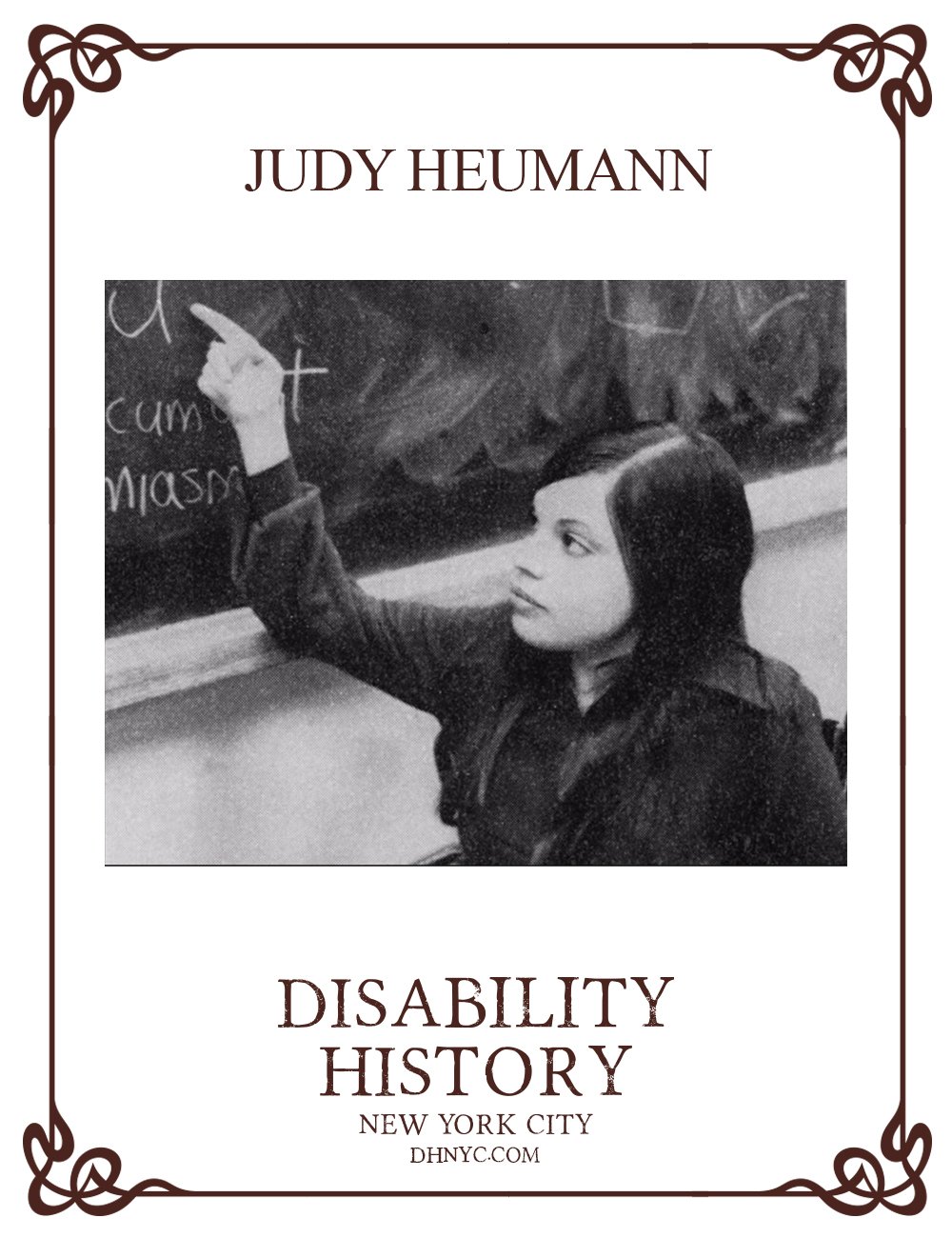
In Image No. 1 – Judy Heumann ca. 1971, from her days as a public school teacher
Judy was chosen.
Born in 1947 to immigrants who fled the Nazis, Judy grew up in East Flatbush, Brooklyn, and contracted polio at 18 months old. Judy’s parents went to bat for her repeatedly during her childhood. They saw to it that she got a meaningful education, and that she actively socialized, not only with nondisabled kids at home in Brooklyn, but also with disabled kids at Camp Jened, one of the most generative sources for disability activists. There she joined other leaders-to-be, including Bobbi Linn, Frieda Tankus, and Kipp Watson.
Judy wanted to be a public school teacher. But the Board of Ed refused to give her a teaching license because she was unable to walk. They came right out and said so.
Judy’s license rejection became a cause celebre. It’s easy to say that Judy made a good symbol—she’d obviously been treated unfairly, and she was extremely articulate, a petite, blond, hippie-looking young woman in a wheelchair. But no one then could have predicted that the blond hippie would go on to become the most important disability activist in the history of the world.
In the wake of the license fracas, Judy co-founded what later became known as Disabled in Action, the first truly militant disability rights group. DIA became famous for its spectacular acts of civil disobedience, which included blocking traffic on Madison Avenue to protest Nixon’s veto of the 1972 Rehabilitation Act, picketing the United Cerebral Palsy Telethon, and members throwing themselves in front of buses for failing to provide wheelchair access.
Soon enough she was lured away to California, where she joined Ed Roberts and the Rolling Quads at Berkeley, and helped build the Center for Independent Living, the pioneering first Independent Living Center.
From there her pace picked up even more. In 1977 Judy helped lead the nationwide Section 504 Regs protests, including the nearly month-long occupation of the federal building in San Francisco. Judy played an integral role in the Individuals with Disabilities Education Act (IDEA) and the Americans with Disabilities Act (ADA). She co-founded the World Institute on Disability, and served as advisor to Presidents Clinton and Obama, the World Bank, and the Global Partnership for Disability and Development.
This breathtaking global reach hit its pinnacle around 2009, with the United Nations Convention on the Rights of Persons with Disabilities, an international treaty modeled on the ADA. Sadly, Senate ratification was scuttled in 2012, based on claims that it would create new abortion rights and impede homeschooling-- even, absurdly, that the treaty would infringe on U.S. sovereignty. Nonetheless, as of 2025 more than 160 other countries have signed on.
Judy retired in 2017. Her memoir was published in 2020, together with a documentary that featured her heavily—Crip Camp, executive-produced by Barrack and Michelle Obama.
New Yorkers justly take pride in our homegrown star, Judy Heumann, who created a record of accomplishment that may one day be equaled, but will never be surpassed.
Note: a version of this entry appeared in Able News, ablenews.com
by Warren Shaw
