Curtis Brewer

Sepia-toned photograph of adult Black man with shaved head, wearing a white shirt and tie.
These days people call them superpowers: disproportionate abilities wielded by regular mortals. Superpowers can be small, even cute—someone, say, who can identify any Beatles tune in less than two seconds, or who does amazing card tricks. But it’s a whole other story when one of those superpowers lines up with its owner’s greatest ambition.
Curtis Brewer was one of the latter. Among the pioneers of the New York City Disability Rights Movement, he was the most profoundly disabled, and one of the few people of color. Aside from his other talents, though, Curtis had a strikingly outsized, almost supernaturally compelling presence. Very much a man who went his own way, Curtis Brewer notched a whole list of disability rights accomplishments. He won quite a bit of recognition for a while, but like so many leaders of our movement he’s gradually faded into obscurity.
Curtis was born in 1925, in Cambridge Massachusetts. Early biographical information is sparse, but by 1955 he was living in the Bronx and may have been working as a letter carrier. He was studying at the New School and dating a woman named Bettie, when he began experiencing symptoms that were initially diagnosed as arthritis. Soon he was unable to feel a coin in his hand, and a month later he was in a hospital bed, paralyzed from the neck down--permanently, it turned out--by a viral infection known as transverse myelitis.
Curtis, however, not only finished his undergraduate degree, he married Bettie and fathered a son.
It is not clear when he became politically active, but Curtis made an important mark as a disability activist at one of the modern movement’s most formative events, the towaway picket of 1967. Hastily assembled in response to a new rule barring all parking in midtown, people with disabilities marched and rolled in front of City Hall, the first civil disobedience by disabled New Yorkers in more than twenty years.
While people like Julie Shaw traded blows with the politicians, Curtis liaised with the press. Archival video shows him adroitly handling the reporters, turning aside veiled insults, resisting pigeon-holing. Rather than the helplessness then expected from people with disabilities, Curtis radiated power at ease. He put the protesters’ case to the journalists, then cannily spoke of his hope that a peaceful solution could be arrived at—“we’re willing to do all reasonable things to resolve the problem, because we are convinced that the problem can be resolved.”
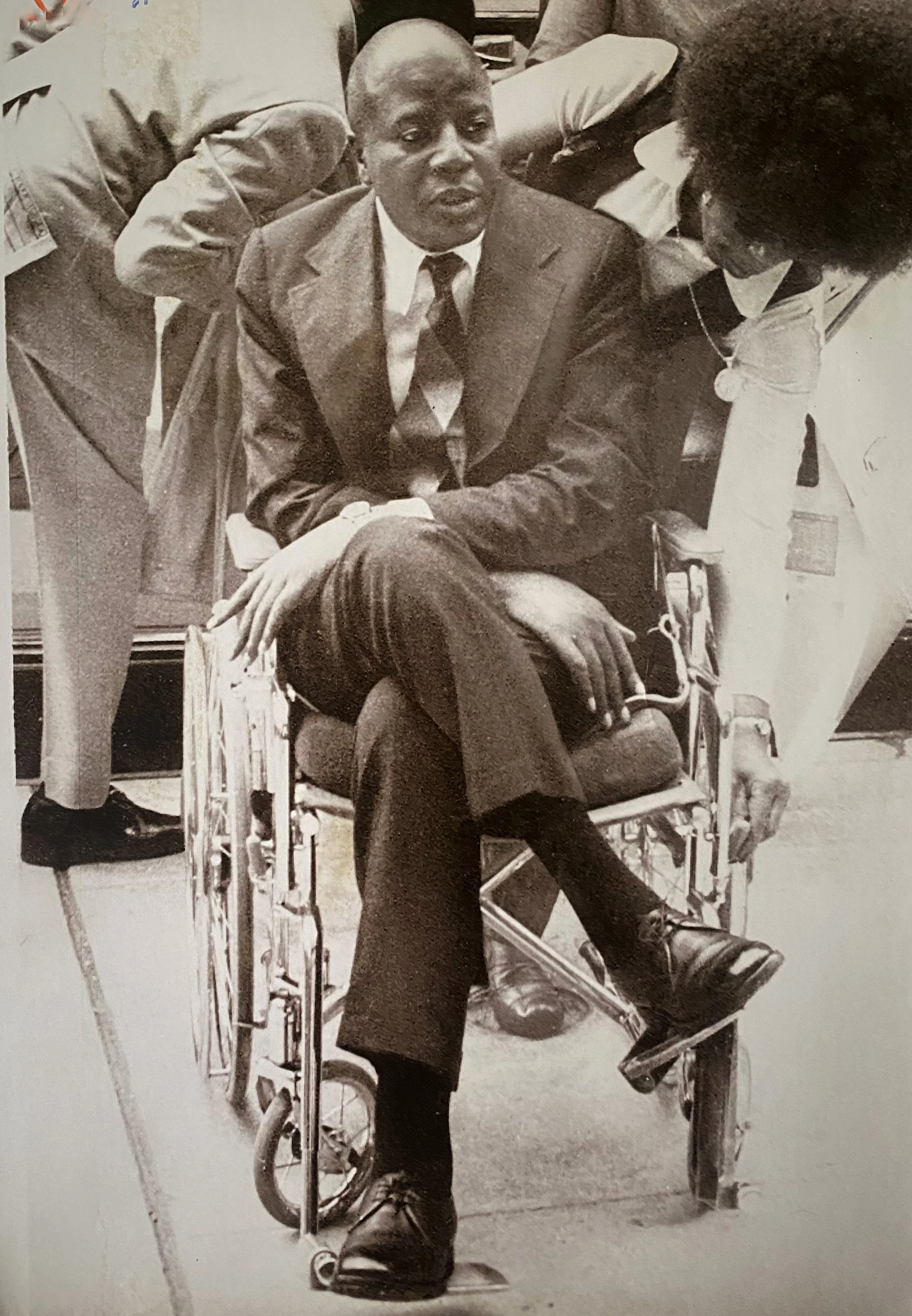
Curtis Brewer on Oct. 2, 1974, the day he was admitted to the bar of the State of New York.
It was peak protest era, 1967. Any mention of a peaceful solution, then, raised the possibility of an UN-peaceful solution. Especially when the message was coming from a Black man.
The towaway protest was an historic success. It helped establish the disability rights movement in New York City, and led to what is now known as the Mayor’s Office for People with Disabilities (or MOPD).
It was during the towaway fracas that I met Curtis. I was eight years old. He was a big guy, extremely good looking, posed in his wheelchair with one leg crossed over the other. That he didn’t shake hands felt more like majesty than disability.
By 1970, now living in lower Manhattan, Curtis enrolled at Brooklyn Law School and embarked on an extraordinary journey towards becoming a lawyer, as a quadriplegic. His wife typed out the class notes that he mentally collected during the day and dictated to her at night. In 1974 he was admitted to the bar. Armed with his law license, Curtis founded an advocacy group called Untapped Resources, and developed a legal practice that included, among other things, physical accessibility claims and Social Security benefits cases.
Curtis always had an office staff, and a number of people shuttled through over the years. One of them was a young college grad named Ruth Lowenkron, hired in 1981. Now well known as the longtime Director of the Disability Justice Program at New York Lawyers for the Public Interest, Ruth recalled her experience in Curtis’ office:
He ran a tight ship. He was very clear that you had to arrive by a certain hour, no arriving late. One day I came in wearing pants, and a client was coming. I had to go out and purchase a skirt! I still have it by the way. He was pretty demanding and particular, but there was a lot of mutual respect, and my two years with Curtis pretty much set the path for my legal career.
Like many of our movement’s pioneers (including my parents), Curtis could be unyielding, even rigid when it came to The Cause. As he once put it, “I don’t go through back entrances, and I don’t ride in freight elevators. I’m not freight and I’m not garbage. That’s just not for me baby—I’m too old or too Black or too something.”
Curtis became friends with the famed (and disabled) Israeli-born violinist Itzhak Perlman. In 2021, Mr. Perlman described to me Curtis’ fury when he couldn’t attend Mr. Perlman’s performance at Carnegie Hall:
[Curtis] was on the 56th street side, he couldn’t get up the steps. He refused to be carried. And he was saying I’m running out of air because the batteries for his respirator were running down. He made a big scandal, there was a demonstration.
He was not polite, never satisfied. That’s what made him relevant, his tenaciousness. He was a bulldozer.
He was important. If people don’t listen to you, you’ve got to shout.
The upshot was the disability community’s first-ever access to one of the world’s great concert venues, Carnegie Hall.
In spite of his increasingly severe disability, Curtis was married three times and raised three children.
Curtis rarely affiliated for long with disability groups other than his own, but over time his blend of skill and stubbornness led to profiles in publications ranging from academic journals to Jet magazine, and appearances on talk shows like Positively Black. In 1980 he was named Handicapped American of the Year by the President's Committee on Employment of the Handicapped.
Curtis always went his own way. A man who “couldn’t move a beard hair” (as my father Julie once described a quadriplegic colleague), Curtis turned his paralysis-downsized, low-decibel voice into an effective weapon. And by the time he passed away in 1990, age 65, the onetime letter carrier had carved a singular path.
We can take pride in Curtis’ story. We can try to learn from him, as with all our movement’s great leaders.
But only if we remember him.
by Warren Shaw
Note: A version of this entry appeared in Able News, https://ablenews.com/
